I. The Star of Bethlehem and the Magi in the Holy Scriptures - II. Representations and interpretations of the star in the Tradition - III. Some associations with astronomical events. 1. Probable association with a nova or supernova. 2. A comet? 3. Meteorites and globular lightning. 4. A variable star? - IV. The "Star" of Bethlehem as a planetary conjunction - V. The birth date of Jesus of Nazareth - VI. The Star of Bethlehem and the work of a scholar on the relationship between science and faith.
In the traditional artistic representations of the Nativity of Jesus of Nazareth, there is a reference to an astronomical event, commonly known as "the Star of Bethlehem." The background is the Biblical text of the Gospel according to Matthew (Matthew 2:1-11). The most common way of describing this "star" is to say that it was a "comet." Actually it appears on the most famous artistic works, and it is shown thus in most of the artistic, or familiar, Cribs in the Christian tradition.
Besides spiritual and theological commentaries, in which sometimes the star was catalogued as a "miraculous event," over the centuries there have been questions about the physical reality and the nature of such a celestial phenomenon as is described in the Gospel. This last question has, in a general view, some interdisciplinary aspects, because a study on what originated the phenomenon seen by the Magi is also a study about the relations between the Biblical Revelation and the natural world. From a theological perspective, such a study would deal with those meanings, allegorical or symbolical, connected with the star: the Biblical hermeneutic can discover and evaluate these meanings in the light of theological and ecclesiastical tradition. From an interdisciplinary scientific point of view, we try to determine whether and how the Star of Bethlehem can be associated with a real natural astronomical event. Among the positive effects of this association, there are also decisive elements for a definitive historical dating of Christ's birth (see Firpo, 1983). There is a fairly wide recent bibliography (many articles and some books) on the matter, which means that interest is still high (see Hughes, 1979; Martin, 1996; Teres, 2000). Minor, but valuable, attention has been dedicated by theologians and exegetes (see Holzmeister, 1942; Rosenberg, 1972; Quéré e Léna, 1996).
I. The Star of Bethlehem and the Magi in the Holy Scriptures
The Gospel of Matthew is the only source in the New Testament that talks about this topic, calling it a "star" (Gr. astér). The full text says: "When Jesus was born in Bethlehem of Judea, in the days of King Herod, behold, magi from the east arrived in Jerusalem, saying, 'Where is the newborn king of the Jews? We saw his star at its rising (Gr. tòn astéra en têi anatolêi) and have come to do him homage.' When King Herod heard this, he was greatly troubled, and all Jerusalem with him. Assembling all the chief priests and the scribes of the people, he inquired of them where the Messiah was to be born. They said to him, "In Bethlehem of Judea, for thus it has been written through the prophet: 'And you, Bethlehem, land of Judah, are by no means least among the rulers of Judah; since from you shall come a ruler, who is to shepherd my people Israel.'" Then Herod called the magi secretly and ascertained from them the time of the star's appearance. He sent them to Bethlehem and said, 'Go and search diligently for the child. When you have found him, bring me word, that I too may go and do him homage.' After their audience with the king they set out. And behold, the star that they had seen at its rising (Gr. en têi anatolêi) preceded them (Gr. proêghen autoús), until it came and stopped over (Gr. estáthe epáno) the place where the child was. They were overjoyed at seeing the star, and on entering the house they saw the child with Mary his mother. They prostrated themselves and did him homage. Then they opened their treasures and offered him gifts of gold, frankincense, and myrrh. And having been warned in a dream not to return to Herod, they departed for their country by another way. [...] When Herod realized that he had been deceived by the magi, he became furious. He ordered the massacre of all the boys in Bethlehem and its vicinity two years old and under, in accordance with the time he had ascertained from the magi." (Mt 2:1-12.16)
The text we have of Matthew's Gospel is the Greek one. Although there are hypotheses on the existence of an original Aramaic text. The interpretation of the text must, therefore, start from the Greek version. The words en têi anatolêi in verses 2 and 9 have often been translated in the past with the words "in the East," as if they referred to the "place" where the Magi were when they saw the star. The official current Italian translation (and the New American Bible we are using) reads better: "at its rising." The words are used to refer to a stellar object which, following the rotation of the sky caused by the earth's rotation, "rises." According to some authors it refers precisely to the acronychal rising: while the sun sets, the object rises. It is worth noting that this simple interpretation leads to a symbolic reference of the star and not a system for pointing a direction: if the Magi came "from the East," as it is written in verse 1, they could not use as a guide to the West (Jerusalem) something that, in that period, could be seen in the East. We do not know which was the source of information of Matthew about the Magi. If the Mother of Jesus was the referrer, we suggest that she was unlikely to have recorded such a technical meaning.
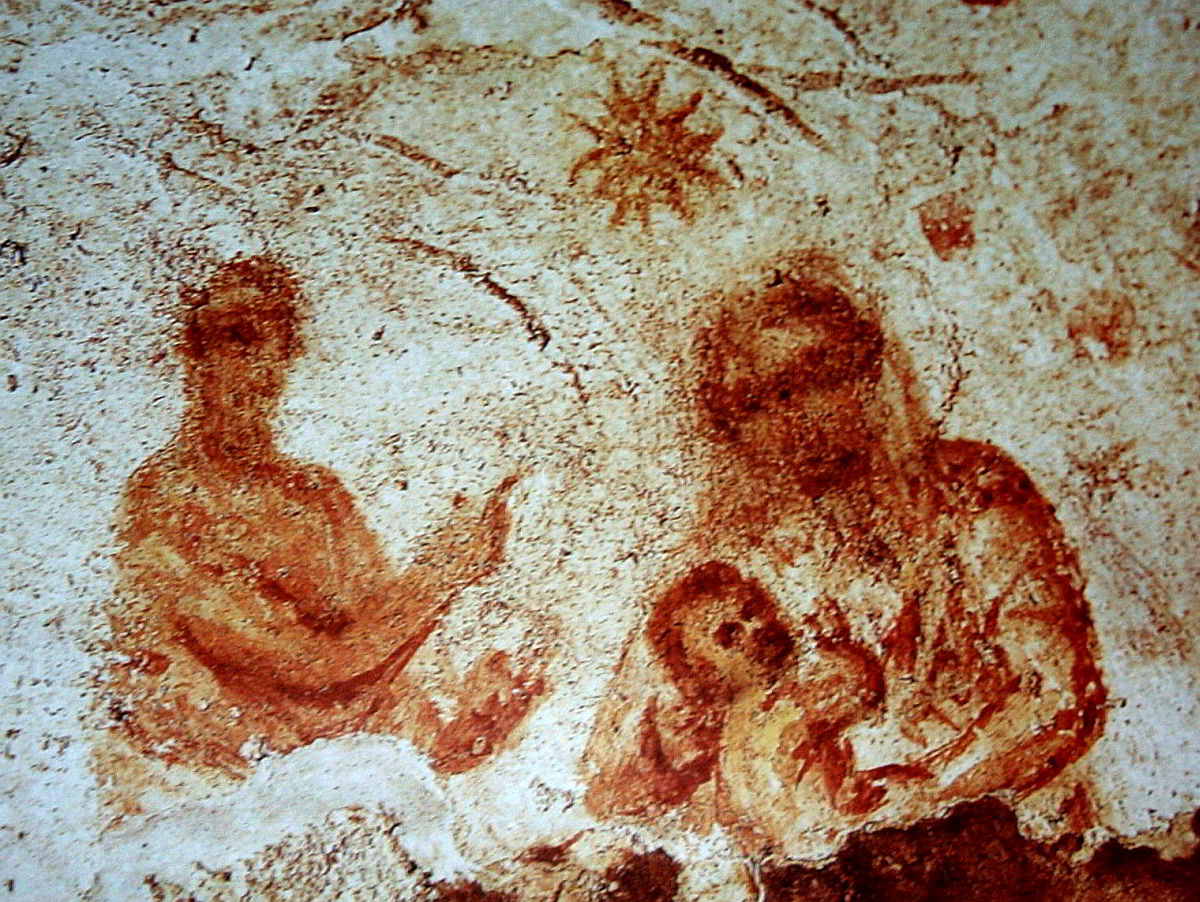
in the Catacombs of Priscilla
In the Old Testament, the Book of the Numbers writes: "A star shall advance from Jacob, and a staff shall rise from Israel." (Numbers, 24:17) These are words by Balaam, sorcerer or magician, who was called by the Moabite king Balac in order to blame Israel and came, on the contrary, to bless it and prophesized a splendid future because he had a divine revelation. The interpretations of this text spring from the identification of the star with King David (this is the origin of the Israeli symbol known as "David's star") to the anticipation of the Star of Bethlehem. The star that comes out of Jacob could be the Messiah himself: this is what some commentaries in the first centuries wrote.
The prophecy written in Matthew 2:6, and referred to by the priests who were called by Herod, is from the Book of Micah: "But you, Bethlehem-Ephrathah too small to be among the clans of Judah, from you shall come forth for me one who is to be ruler in Israel." (Mi 5:1) One can see the difference between this text and Matthew's, which replaces the words "too small" with "by no means least": this does not change the meaning but it reinforces it. It is one of the many demonstrations of the use of citations from the Old Testament, so frequent in Matthew, seen in the light of the New Testament's events. The sacred author was not as keen as we are nowadays on finding a perfect textual match, but he looked for the sense and the symbolism of the prophecies. The other evangelists do not talk about the Magi or the star. For Mark and John, this is not so surprising because their narration starts with the public activity of Jesus, but Luke, who deals with so many details of the birth and infancy, surprisingly does not talk about this episode, either. Perhaps Luke knew Matthew's Gospel and did not want to repeat what he had read. Some authors say that Luke was quite prudent and avoided talking positively about Persians, to whom the Magi belonged, because they were enemies of the Romans.
According to Herodotus (5th century B.C.), the Magi (Gr. mágoi) were a caste of the Medeans, belonging to the erudite priests, who studied the sacred books and watched the sky (see Histories, book I, 101), but the most recent investigations place their origin in Babylonia and Persia, more than in Medea. The Old and New Testament refer with that name to people who were magicians, in the widest sense. Matthew does not speak about "kings," and none of the most ancient Fathers does either; but Tertulian, at the beginning of year 200, writes that the Magi in the East were known as kings. A possible explanation of the title "kings" is the desire to apply prophecies such as that of Isaiah: "Nations shall walk by your light, and kings by your shining radiance." (Is 60:3) or Psalm 68: "Show it from your temple on behalf of Jerusalem, that kings may bring you tribute." (Ps 68:30) The fact that the evangelist Matthew does not cite this and other prophecies, so opportune and applicable to these events, can be a hint on the historical background of the narration of the Magi: knowing that they are not kings, he does not think that these ancient texts are pertinent to their adoration of the Child. If he had only the purpose of making prophecies come true, he would have surely used these. From the first centuries, Christianity started talking about the Three Kings (or Wise Men), also to indicate their importance, and with their adoration, the submission of the powerful men of the world to God made Child.
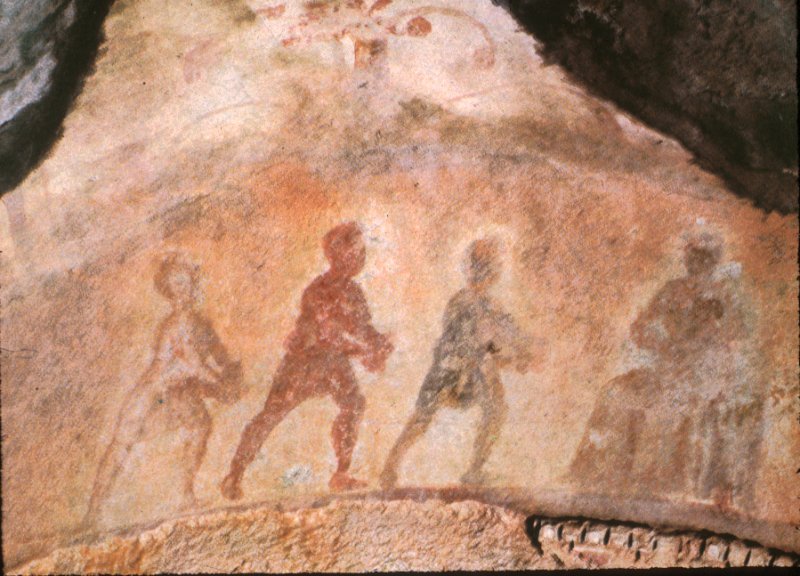
The Magi could have been Zoroastrians and careful watchers of the sky, certainly astrologers, in the ancient Babylonian and Assyrian sense, and not in the Hellenic sense. We note that in the original tradition of Mesopotamia the sky's appearance was seen as a "reflex" and sometimes an "anticipation" of what happened on Earth, but without any implication of causality and astrolatry. We do not know the number of the Magi: Christian tradition shows two of them in a fresco of the 4th century in the catacombs of Saints Marceline and Peter in Rome, three or four are present in other famous catacomb representations, but also up to fourteen. About their names; starting from the 7th century, we find sources talking about Gasper, Melchior, and Balthazar, as the Venerable Bede (673-735) states, specifying that the third one was a Black. Remains which are thought to be theirs were found in Persia and were taken to Constantinople by St. Helen or by Zenon the Emperor, and later moved to Milan in the 5th century. Finally, they were taken to Cologne in the 12th century, where they are now greatly venerated in the Cathedral. At the end of his speech in 1980 to scientists and university personnel gathered in that Cathedral in Cologne, Pope John Paul II mentioned the Magi (see Insegnamenti, III, 2[1980], p. 1211).
In order to guess from where they came, we can estimate the time taken from their land to Jerusalem. According to where you place their home in Mesopotamia, distances may vary between 800 and 2000 km; keeping an average of 50 km per day (a normal pace for the camels of caravans crossing the desert), the net duration of the trip could have been around 15-40 days. But we cannot exclude that a similar journey could take longer. About their origin, Tertulian says that they came from Arabia, literally applying the messianic Psalm 72: "May the kings of Tarshish and the islands bring tribute, the kings of Arabia and Seba offer gifts." (Psalms 72:10)
It seems that, according to the data we have from the Gospel, the visit of the Magi did not happen in the same, provisional, birthplace of Jesus. In 2:11 of Matthew's Gospel, there is an explicit mention of "house" (Greek: oikía); the chronology of the events leads to a visit after the circumcision, eight days after the birth (see Lk 2:21), and the presentation of Jesus to the Temple with his Mother's purification at the fortieth day (see Lk 2:22). There is, finally, a reference to the Star of Bethlehem in the Protoevangelium of James, an apocryphal text of the 2nd century. As usual in this kind of source, the descriptions are often exaggerated and emphasized, therefore the reference to a star "so bright to make all the other stars disappear" cannot be considered valid in order to understand the physical nature and the appearance of the celestial body.
From a summary of what we have seen in the analysis of the text of the Gospel and what we can deduce from it, we can extract some minimal requirements that a natural explanation of the Star of Bethlehem (that is, a real natural object or phenomenon) should have. The star must have been seen from a Country to the East of Palestine, while rising. It would not have been such a clearly visible object in Jerusalem, otherwise we cannot understand why Herod - and with him the whole town - were surprised when the Magi told him about the star appearing. It is also possible that, in Jerusalem, they saw the star but did not associate it with the birth of the Messiah, otherwise Herod would not have asked the Magi to tell him "the exact time the star had appeared." We are dealing with a phenomenon clear enough to justify a journey to Jerusalem, but at the same time evident only to "professional" watchers of the sky. The Gospel does not say anything about a star that "shows the path" to Jerusalem from the Magi's country; only for the final part, from Jerusalem to Bethlehem, Matthew 2:9 says: "the star . preceded them ." Generally speaking, we should say that, according to the text, the Magi were forced to go to Palestine, not because they had a "pointing sign," but for some other reason.
In the text, we notice with surprise that Herod did not follow the Magi, or order them to be followed to Bethlehem, bearing in mind that it is only 10 Km from Jerusalem. Even though the Gospels describe Herod as very suspicious, perhaps he trusted them, or did not want to be impolite to such important guests. On the other hand, it is not strange that he called them secretly: this is in harmony with what we know about the Jewish king, and we can imagine that he did not want to produce any gossip about his interest in the future Messiah, who would take over his reign. In the Judaic vision of that time, the Messiah was expected to be a king, and liberating, who would redeem his people from foreign domination.
Going to Bethlehem, the Magi saw again the star that "preceded them" (Mt 2:9). If we read literally this description, we find it very hard to associate it with a natural phenomenon. The first point is that the star can be seen from Jerusalem in the Southern sky (that is pointing to Bethlehem), while the meaning of "stopped over" is not very clear. It may mean a vertical high position, or a low one, indicating the house from a far location. The Greek verb, in its passive form, suggests simply "staying still" while the adverb "over" indicates the position. The text finally says that the Magi were overjoyed when they saw the star again, because its reappearance was a confirmation that Bethlehem was the correct destination. This emotion is similar to the one that a scholar feels when he or she achieves an experimental confirmation of a scientific deduction or a theoretical prediction.
II. Representations and interpretations of the star in the Tradition
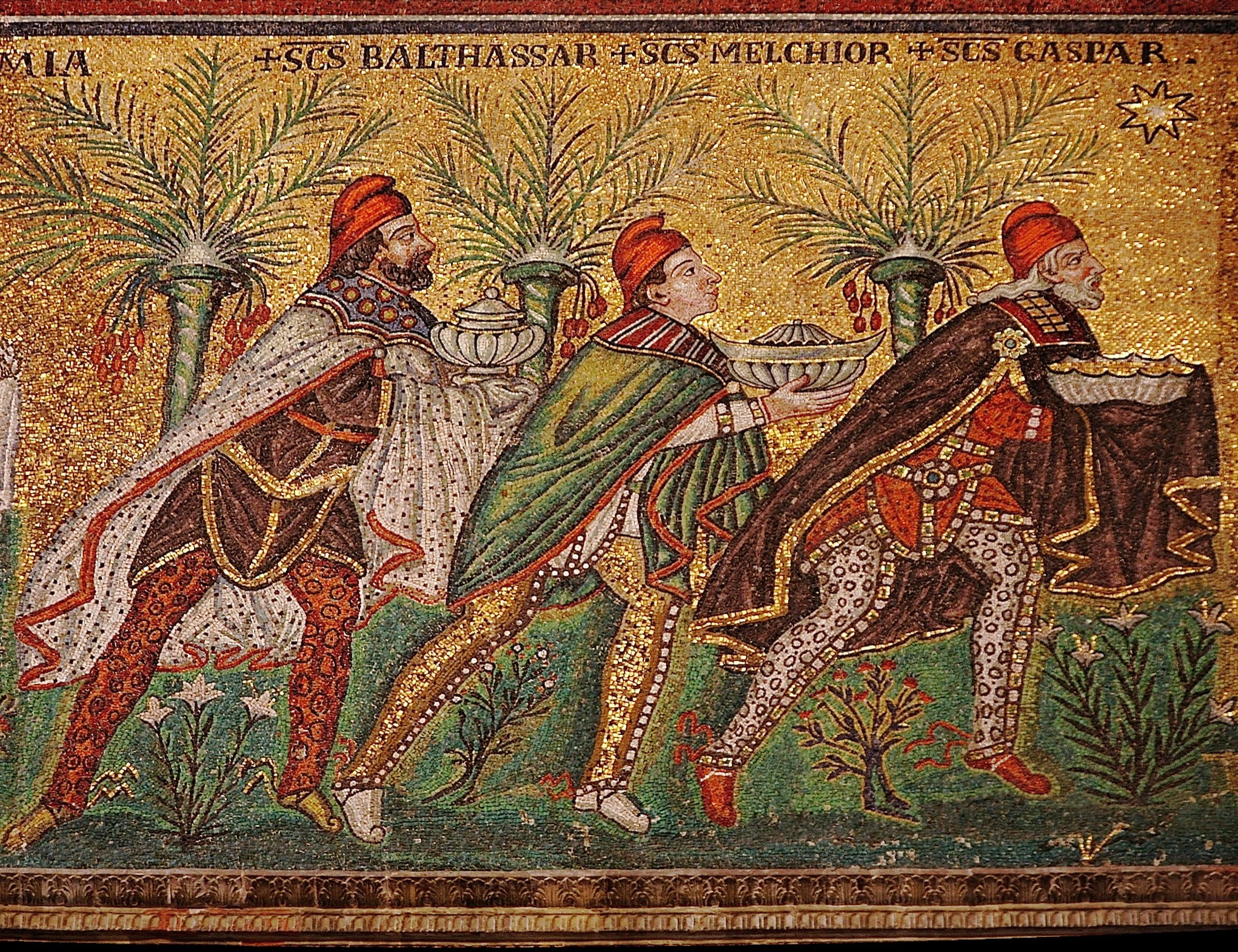
of St. Apollinare Nuovo in Ravenna
In almost all artistic representations of the Nativity that show the Magi adoration, there is also a "star," often represented as the typical sign of the place where Jesus was born. The most famous picture is probably the fresco of the rich biblical cycle in the Scrovegni chapel in Padua, by Giotto at the beginning of the 14th century. In this fresco, the star has a tail, to show that it was like a comet, a celestial object, not very frequent, but well known in ancient times. It seems that Giotto, while painting a realistic comet, was thinking of Halley's comet, which has a period of about 76 years around the sun. This was visible in 1301, when passing near the Earth. The oldest pictures, on the contrary, depict a star with no tail. There are eight spikes in the mosaic, from 433, of St. Mary the Major in Rome and, in Ravenna, and in the one of St. Apollinaire The New, from the 6th century, in which there is a peculiar pair of stars, one inside the other. On the 4th century's marble sarcophagus of Adelfia, found in St. John's catacombs in Syracuse (Sicily), one of the Magi points to a seven-ray star. From around the year 330 is the sarcophagus front found in the Vatican in which one of the three adoring Magi, near two camels, points to a wheel-shaped six-ray star. In the most ancient representation of the Magi - in the fresco of the catacombs of Priscilla in Rome, dated 2nd century - there are three of them, but the star does not appear, maybe because the highest part of the painting is completely ruined. The star appears, however, in a fresco depicting the Virgin Mary and Balaam who points at it. Among the common elements of most of these representations, we have to mention the somatic differences of the Magi. Changes took place through the centuries as new populations were discovered, indicating the universality of Christian Redemption and the call to salvation for all people.
Among the most ancient authors who tried to find a natural event for the Star of Bethlehem, we find Origen (about 185-253), who writes a couple of centuries after the birth of Jesus of Nazareth. He favours a physical interpretation and, in order to differentiate the Magi's behaviour from the astrological practice of the Chaldeans, he describes it as a "new" star, different from known ones (and therefore not forecast or linked to horoscopes), similar to celestial phenomena such as comets (cf. Contra Celsum, I, 58-59). He cites a book by the stoic Chaeremon, Nero's preceptor, called On the comets, noting that it was common habit to understand that a comet or a new star was associated with the birth of important persons. He reminds his adversary, Celsus, about the prophecy of Numbers 24:17 (see above I) and, with it, he justifies the Magi's travel. Ireneo from Lion (2nd century) writes about the star referring to the fulfilment of Balaam's prophecy, but he does not draw a conclusion about its natural origin (see Adversus haereses, III, 9:2). Differently, St. John Chrysostom (about 350-407) thinks that the star was a real miracle, because he cannot reconcile what the evangelical narration says of the star with the normal characteristics of celestial objects.
The Chrysostom dedicates to the Star of Bethlehem, and to its symbolism, the whole sixth homily in his Comment to the Gospel of Matthew (see PG 57:61-72). He writes in a Hellenic environment, and thus clearly states that the star in the Holy Scripture does not have any astrological meaning, like horoscopes and vaticinations (see V,1). The travel of the Magi to Judea is somehow a paradox, because it means humility from their side: they are going to accept a recently born king, where nobody would have gone to find him... The author seems to conclude that "the star of the Magi was not an ordinary star, moreover it was not a real star, but an invisible force that took the appearance of a star [...] Think, therefore, from where the Magi had the idea of travelling and what made them start it. I think that it was not only the work of the star, but also the work of God who moved their souls" (VI, 2.4). He wants, at the end, to emphasize the spiritual dimension of the journey and of the understanding of the star, but he does not exclude the existence of a sensible sign that is miraculous because it was not linked to any natural ordinary or extraordinary phenomenon of the sky.
Special attention is given to the comment on the Magi episode by Pope Leo the Great (440-461) in his eight Sermons about the Epiphany (PL 54:234-263). In the third of these, we read: "A star more brilliant than the other stars arouses wise men that dwell in the far East, and from the brightness of the wondrous light these men, not unskilled in observing such things, appreciate the importance of the sign: this doubtless being brought about in their hearts by Divine inspiration, in order that the mystery of so great a sight might not be hid from them, and, what was an unusual appearance to their eyes, might not be obscure to their minds." (Sermones XXXIII:2) The author, even developing in this, and in other sermons, the allegoric and spiritual meaning of the narration, is keener to present a natural event as the start of the Magi to understand the highest meaning of it. The logic is more explicit in the first sermon: "To three wise men, therefore, appeared a star of new splendour in the region of the East, which, being brighter and fairer than the other stars, might easily attract the eyes and minds of those that looked on it, so that at once that might be observed not to be meaningless, which had so unusual an appearance. He therefore who gave the sign, gave to the beholders understanding of it (dedit ergo aspicientibus intellectum, qui praestitit signum), and caused inquiry to be made about that, of which He had thus caused understanding, and after inquiry made, offered Himself to be found." (Sermones XXXI:1) An interesting relation to the universality of the cosmic language - an object of science - can be found in the link, proposed by St. Leo, between the celestial and somehow public dimension of the sign and the universal vocation of all people to know the event and the grace of Jesus Christ. He notes that, while the recognition of the Messiah by the Baptist at the beginning of his public life, and previously the annunciation to Mary, and the news of his birth given to the shepherds, were a matter for a few people, "this sign that efficaciously moves the Magi from far countries and attracts them with a irresistible force to Jesus, Lord, with no doubt is the sacred sign of that grace and the start of that vocation for which not only in Judea, but all over the world the Gospel would have been preached. [...] The meaning of these mystical facts is still present: what started in the image is now reality. The star irradiates from the sky, as a grace, and the three Magi, called by the brightness of the evangelical light, every day in all countries come to adore the power of the highest King." (Sermones, XXXV:1-2)
As far as the biblical exegesis is concerned, we have to notice that, quite often, it has read the evangelical text in the framework of the Midrash, a way of interpreting the Scripture typical of Judaism. The author of the Gospel According to Matthew writes in a Hebraic environment mainly for Jews and, therefore, may have been using the Midrash that is reviewing the events in the light of the previous biblical tradition, associating what happened in those years to episodes and images already written in the Old Testament. The whole Magi's story, or perhaps only the appearance of the star, may be an example of haggadic midrash (which refers to moral, philosophical and theological matters and is different from halakhic, which refers to legislation), built by the evangelist to demonstrate the fulfilment of the prophecies of Balaam or Micah or Isaiah 41:2-3. The latter talks about the Persian king Cyrus (of whom, the star in the East or the Magi coming from his country, could be an image) who frees the people of Israel from Babylonian slavery. It could be, talking in modern TV language, a fiction, a likely representation, based on real events. This would not exclude the historical background but would influence the elements of the narration. In line with the midrashic reading, the star and its brightness could also be a way of representing the glory of God (Hebraic: kabod Yahweh), which was visible as a cloud, a light or a flare, covering the place where Yahweh was present, the Tabernacle (Hebraic 'ohel) of the Exodus and, later, the temple of Jerusalem (see Exodus 40:30-34; 1 Kings 8:10). The birthplace of Jesus Christ, visible in the humble and insecure tent, but a figure of the real and invisible temple, would be covered by the brightness of the star, as bright was the cloud of the divine glory in the Old Testament. The exegetes have not dealt with astrological and divinatory explanations, because it was a condemned practice in the Old Testament (see Is 47:13-15; Jer 10:1-2; see Sky) and it was rejected by Christianity.
III. Some associations with astronomical events
Astronomers and scientists are not unanimous on interpretations of the Star of Bethlehem, and their attitudes range from avoiding any association with natural events to trying to find a perfect match with some of them. The first thesis, logically, is not linked to a religious option, because those who take the Gospel as a historical document, may correctly follow a spiritual interpretation and interpret the star event with a "typical or figurate meaning." The astronomers' thesis may be summarized in the two major examples: Tyco Brahe (1546-1601), who said that the star was not a natural phenomenon at all (see Opera Omnia, Frankfurt 1648, vol. I, pp. 239, 420-423) and Johannes Kepler (1571-1630), who first tried to associate it with a nova and later with a planetary conjunction (see Opera Omnia, Frankfurt 1863, vol. IV, pp. 3 and 46). We shall now examine briefly the main astronomical interpretations for the Star of Bethlehem.
1. Probable association with a nova or supernova. Some stars, in particular moments of their thermodynamic evolution, may rapidly increase their brightness. This is essentially due to two causes. In the first case, which is typical of the novae, as soon as the thermonuclear energy source of a star belonging to a binary system is exhausted, it can collapse into the form of a white dwarf, or even denser object, such as a neutron star, attracting all the superficial gaseous layers of the companion star which, falling at high speed towards the collapsed star, gets hotter and emits sudden and intense thermal rays. The total brightness of the original stellar system grows by some magnitudes, though for only a few weeks. In the second case, a single, but larger, star can explode like a supernova at the end of its evolution because of the irreversible instability between the force produced by its radiation and the gravitational force of its mass. Depending upon the value of the stellar mass, the phenomenon may vary, but we always notice the sudden emission of a great quantity of energy, of both visible light and other frequencies which later decrease slowly. In both cases, we see in the sky the sudden appearance of a star, which before the event was fainter or invisible to the naked eye. Obviously, this does not mean that it is brighter than the brightest stars in the sky: this can happen statistically in only a limited number of cases.
Many old, and more recent, stories record a multitude of novae and supernovae visible to the naked eye (the number visible through a telescope noticeably increases with the improvement of technology). From Chinese annals, we have highly detailed recordings of novae visible to the naked eye. Between 100 B.C. and 1690 A.D. there was an average of one every 20 years, which means they were not very rare events for the astronomers. Good candidates, from their dates of appearance, are those of 5 B.C. and 4 B.C. (see Hughes, 1979, chap. 7). These were "new" stars, to be added to those already known, that is, the fixed stars in the scenario of the existing constellations. For our purposes, it is important to note that we are dealing with stars whose brightness in the visible part of the spectrum rises to a peak that lasts for only a short period, just a few days, and later slowly decreases until it stabilizes (with differences among the types of novae and supernovae) at a much lower level. We also have to note, for a good historical interpretation, that novae did not have a good reputation among the astrologers of the period: as it was not possible to forecast them, they thought that novae would portend negative events.
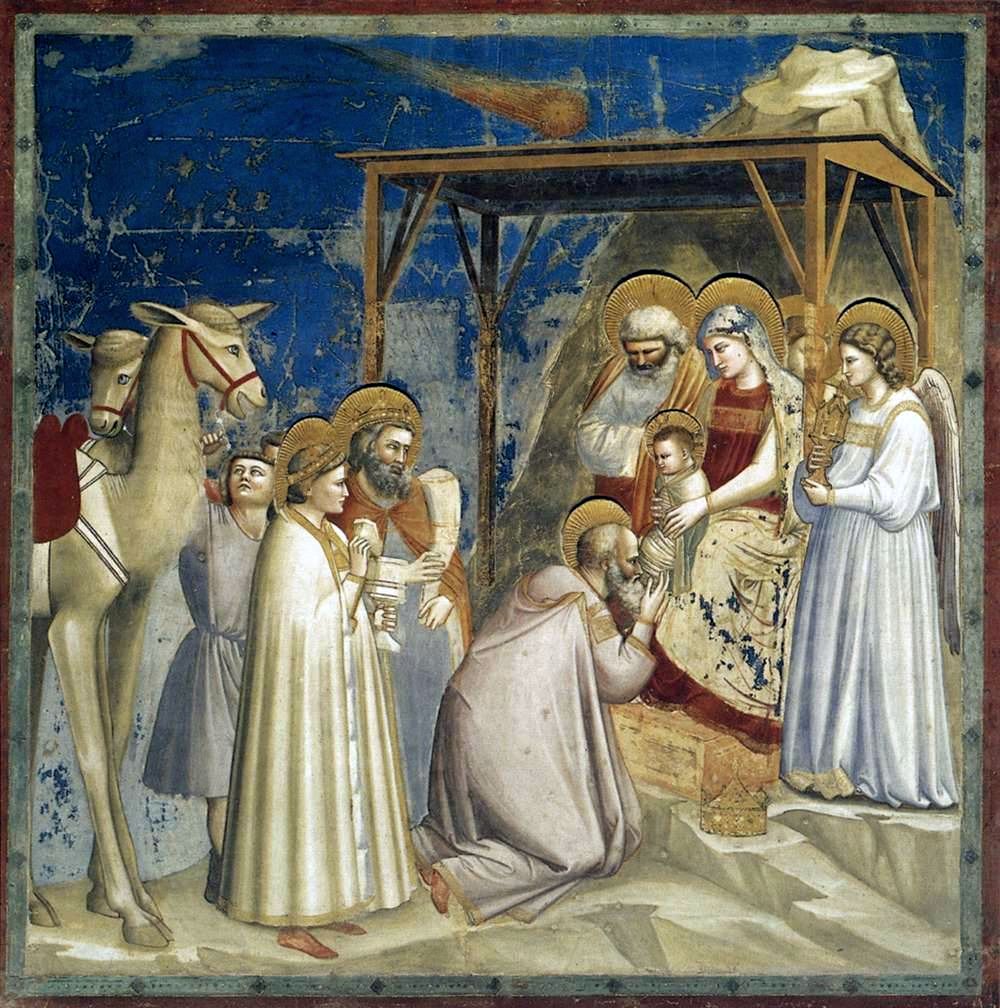
in the Scrovegni Chapel in Padova
2. A comet? Comets are solid bodies orbiting the sun, though much smaller than planets and their satellites. Their orbits are highly elliptical, that is, very stretched; in a limited number of cases, they can be objects, external to the solar system, that the gravity field of the sun has captured forcing them on parabolic or hyperbolic orbits that are not recurring. As the comet approaches the sun, a large part of the material on its surface evaporates, forming a tail of gas. This is pushed by the swarms of particles coming from the sun - the so-called solar wind - and becomes bright, producing the tail of dust and ionised particles, the direction of which varies along the orbit, being always directed away from the sun. The brightness of a comet seen from the earth depends upon its size and distance from the sun, growing as the distance decreases, even though this proximity makes the comet more difficult to see, being visible only near sunrise and sunset. The phenomenon is spectacular, and the tail points to a direction; with its slow movement with reference to the fixed stars, the Star of Bethlehem has been classically associated with a comet.
Chinese and Babylonian astronomical almanacs provide a list of all the comets that were seen in the first ten years before Christ. The well-known Halley's comet, named from Edmond Halley (1656-1742) who was the first to identify it, has an orbit with a period of 76.3 years and passed near the earth in 12 B.C. It may be the comet mentioned by Dio Cassius and the Chinese astronomers. This date is too early if we relate it to other specific sources for the birth date of Jesus Christ (see infra, V).
We have to note that, in the astronomical registers of the past, it has not always been easy to distinguish comets from novae. Even though the terms used are normally different, there are some ambiguities which lead to an interchange of names, notwithstanding the easy way of distinguishing them, because the position of the comets varies day by day with reference to the fixed stars. The movement of novae, on the contrary, is not recorded by the naked eye, as they are proper stars. In Chinese annals, the tail normally indicates a comet: they write about hui hsing (or sui hsing), that is, a star that "swipes the sky." The nova of March 5 B.C., clearly visible for more than 70 days, is also called hui hsing (and therefore could have been a comet), but no movement with respect to fixed stars is recorded. There are doubts if an object without tail, seen in April 4 B.C., was a comet or a nova, similarly for another in 10 B.C.
The main objection to the identification of the Star of Bethlehem with a comet is astrological. Generally speaking, comets foretold disasters and were not particularly rare or extraordinary, even though they could be spectacular. Why would the Magi start traveling just for that event? Anyway, the interpretation of comets as carriers of misfortune is not universal: there are some cases when they are associated with good news. A comet follows the criteria of "appearing" twice: the first when it is approaches the sun, the second when it recedes (as we have already noted, the tail is brighter when the comet is nearest to the sun). Between the two periods there is a time when the body is not visible because it is in heliacal conjunction (that is too near to the sun to be seen). When comparing the event with the biblical text, we note that, even if a comet moves with reference to the stars, this movement is not so fast as to move clearly in a few hours, that is in a reasonable time for travelling from Jerusalem to Bethlehem. The evangelical expression "went ahead of them until it stopped over" cannot be taken literally in the case of a comet. An interval of two years, that is the period between the birth of Jesus and the maximum age he could have been when Herod decided to kill the innocent babies (see Matthew 2:16), would be too long if you take it as the period between the first and second appearances of the same comet. If the star were a comet, it would have been visible also in Jerusalem, but it would not have been understood as a sign and therefore the excitement of the Jews could only have been due to the "interpretation" of the Magi.
3. Meteorites and globular lightning. Small asteroids and wandering stones in the solar system cross the earth's path and enter the atmosphere at high speed, burning and emitting a strong light. Sometimes they are not completely destroyed and fall to our planet's surface. The light lasts for a few seconds and there may also be some noise (bolides). The frequency of these phenomena is high: almost every night they are visible, with particular days on which they are more frequent - when the earth crosses some of the main swarms of meteorites, like on the 10th of August for the Perseids and in November for the Leonids. The only way of making the narration of the Gospel compatible with these objects would be to have a series of large meteorites, but this hypothesis would require too many coincidences. We do not understand why the Magi should have decided to move just when they saw such a repetitive event; the only reasonable occasion could have be a very huge meteorite, but we have no trace of it in the astronomical almanacs of that time. The term "meteor" is used in many senses to indicate a transient phenomenon in the terrestrial atmosphere. Therefore we are not surprised when, grossly, in the note to Matthew 2:2 of the official edition of the Bible by the Italian Bishop Conference, Salvatore Garofalo writes: "the star was a light phenomenon of the atmosphere." Years before, the Enciclopedia Cattolica wrote about it as a "miraculous meteor, not so high in the atmosphere."
Globular lightning is an electrical phenomenon that occurs in the lowest parts of the atmosphere: it is not yet completely understood. It takes different shapes, often spherical. It lasts for a few seconds, or at most for a couple of minutes, and moves in an unpredictable manner and at different speeds, running in strange paths and sometimes becoming stationary. Just for this behaviour, they are the best candidates for a literal interpretation - thinking of a very fast event - of the words: "stopped over." But in order to be compatible with the other parts of the text, we have to suppose the existence of two such instances at two different moments.
There is also a problem in the use of the term aster (star) for an object that is not at all a celestial body. If the Magi were really professional astronomers, they would have not talked about a star to Herod. The problem with the word aster is a general one: if we take the exact meaning, we have to exclude also the translation "planet" (Greek: planétes). We have to remember that, in the Greek version of the Old Testament, the term planes is never used.
4. A variable star? Some stars, well known also to amateur astronomers, vary their brightness in a periodical manner. The variation can be for different reasons, the main two being the pulsation of the thermodynamic structure of the star (pulsing variables) or the periodical eclipses of one or more components of a double or multiple stellar system.
The best candidate for the Star of Bethlehem may be Mira, in the constellation of Cetus. In a cycle of 11 months, Mira can sometimes reach the same brightness as the polar star (a magnitude 2 in the visual brightness scale) or more often magnitude 3, only later to lower its brightness 1000 times, being invisible to the naked eye for about half of its cycle. The reddish colour of Mira could recall to the Magi the divine symbolism of fire in the Zoroastrian Persian culture. The lack of detailed star charts and the limited interest in the variations of stars (which were considered fixed and unchangeable) could lead them to take it as a nova (see above, n.1).
The region of Cetus in which we find Mira is also very near to the place where, in 6-7 B.C., there was the triple planetary conjunction between Jupiter and Saturn (see below, IV), which could have led to more attention being paid to that part of the sky. As soon as they noticed the increasing brightness of the star, the Magi started their journey but, due to the variations of Mira, they lost sight of it. Once in Jerusalem, they asked Herod for suggestions. The king's counsellors did not notice the star because it was not very clear for non-specialist watchers of the sky. The low latitude of Cetus may suggest that the words "stopped over" mean not the vertical position but the horizontal one, serving as a pointing level.
The problems with this interpretation are mainly with the short time it allows for the Magi's travel: only one month, that is the period of the star. Some experts say, though, that it may take only ten days to go from Babylon to Jerusalem if the camels are pushed. The short period is not compatible with Herod killing all the babies younger than two years, according to the information given by the Magi. Moreover, the astrological symbolism (in a wide sense) of the star is not completely defined.
IV. The "Star" of Bethlehem as a planetary conjunction
We will dedicate more space to the hypothesis of a planetary conjunction because there is more scientific literature about it. When two or more celestial objects, stars or planets, seem to be very near to each other, we call it a "conjunction." It is only an optical effect, because their real distance is generally enormous: only projected onto the background of the sky they seem to approach each other. In some cases, they seem to "fuse" in a single visible object. In this case we say that there is an "occultation," which shows us only the nearer object: the maximum brightness is reached when the two bodies are adjacent, before one hides the other.
Before Christmas 1603, Kepler watched a conjunction between Jupiter and Saturn. The minimal distance between the two planets was around an arc degree, that is double the apparent size of the moon. He was interested by the fact that it happened in the Pisces constellation and he related it to some Hebraic traditions that underlined the importance of such an event. He calculated that in the year 7 B.C. a similar conjunction happened but with a more interesting detail: the conjunction occurred thrice in the same year. Between May and December the two planets approached and receded from each other three times. This is possible because the planetary orbits, projected on the celestial sphere of the fixed stars, seem to draw rings, precisely a direct motion and later a retrograde one, caused by the differences in the relative motions of the earth and the planet, that have different speeds of revolution around the sun. The event of a conjunction occurring three times in a few months is quite rare. In the following year, Kepler noticed an even rarer event, that is, the clustering of three planets: Jupiter, Saturn and Mars. It was not a conjunction, strictly speaking, because the distances were of some degrees, but the phenomenon was interesting for those who are used to watch the sky: three very bright objects in the same sky area are a good sight. He calculated that this triple gathering could happen every 805 years. It therefore happened in 799 A.D. (Charles the Great period), in 7 B.C. (the probable birth date of Christ), in 812 B.C. (Isaiah's time), in 1617 B.C. (period of Moses). Going backwards, he reached 4032 B.C. where he assumed the creation of Adam. In October 1604, he saw a supernova, which was visible for a full year. Kepler did not think that these conjunctions could be the actual Star of Bethlehem, but he considered them as spectacular events, which would have attracted the Persian astronomers. It was presumably a "preparation" for the Magi to the great event, which was, according to Kepler, a nova which followed.
The hypothesis of the conjunction has stimulated the interest of many contemporary scholars, because they think that it is the phenomenon that has the greatest chance of being the Star of Bethlehem. The measurements of the positions of Jupiter and Saturn for the year 7 B.C., besides being calculated now, have been found also on astronomical calendars in tablets from Babylon. A tentative reconstruction of the chronology of the events may be the following. In May 7 B.C., the Magi watched the first of the three conjunctions of Jupiter and Saturn in the constellation of Pisces and gave it a symbolic value related to the birth of the Hebraic Messiah. They also calculated the following conjunctions and decided to move to Jerusalem. Around September, they watched the second conjunction, while travelling. In December they reached Jerusalem and asked Herod for information about the prophecies regarding the birth of the Messiah. Soon after, they observed the third conjunction, in the constellation of Pisces, which, after sunset, can be seen in the South, that is, towards Bethlehem. They moved from Jerusalem to Bethlehem in the afternoon, and when the sky got dark, the two planets rose in the Southeast, culminating in the South, high enough to be visible and bright. Certainly, the two bodies never appeared as a single star, therefore the use of the word aster by the Gospel should be taken in a generic sense, not as a technical astronomical term. We can also think that the "star" was only Jupiter (as a symbol of the Messiah, while Saturn could symbolize Yahweh). In their apparent angular motion (Jupiter's is faster than Saturn's), the planets have a "stationary point" at which they seem to stay still with reference to the fixed stars: in the case of Jupiter this would have been clearer, which suggests us an interpretation of the "stopped over" (Matthew 2:9).
Why would this conjunction and not previous ones, which were even more impressive, even though not triple, lead the Persian astronomers to start a long journey? The main reason could be the celestial symbolism. The Pisces constellation was related by the astronomers to the Jews (there were other frequent associations of other constellations to other populations) and Jupiter was considered the planet of royalty. There was the feeling that the Hebraic Messiah was coming; the Magi knew the Scriptures and the prophecies on this, because of the deportation of the Hebrews to Babylonia in the 6th century B.C. and the possible presence of Jews in Mesopotamia produced some diffusion of their traditions. In a Hellenic mythological and astrological framework (that we only suggest here), Saturn (Kronos) was being replaced by Jupiter (Zeus), his son, as the head of all gods, which is somehow parallel (with very different modes) to the awaiting for a Son of God. Finally, it may be interesting to notice that in the iconography of the former Christians, fish (Pisces) is a symbol of Jesus Christ, because the Greek word ichtus (fish) is an acronym of Iesus Christos Theou Uios Soter - Jesus Christ Son of God the Saviour. The fact that the two year period calculated by Herod is not congruent with the timing of the event seen by the Magi can be simply a mathematical rounding upward, to be sure not to be wrong: this is something found in biblical language. If we compare the text of Matthew, in particular, with the other Synoptics we find some "doublings," (e.g. the two "born blind men": see Matthew 20:29; Mark 10:46).
Following the thesis of Ferrari d'Occhieppo (1978), David Hughes (1979) adds other details to the mentioned hypothesis, leading to a probable date of Jesus' birth: the evening of Tuesday, 15th September, 7 B.C. when Jupiter and Saturn rose together opposite the setting sun.
Ernest Martin (1996) says that the Star of Bethlehem was Jupiter, linking it to a series of conjunctions different from the triple one with Saturn. The reconstruction of Martin starts in 3 B.C., when Jupiter is in conjunction with Regulus (literally "little king"), the brightest star of the constellation of Leo. The link with the prophecy of Jacob about Jude, heir of the divine promise, as a lion's whelp (Genesis 49:9) is immediate. According to Martin, 11th September, 3 B.C. is the most probable date of the birth of Jesus. It is the beginning of the Hebraic year (Rosh ha-Shanah), the sun is in the constellation of Virgo and in the morning the moon rises just at the feet of this constellation (note the parallel with Revelation 12:1: "A great sign appeared in the sky, a woman clothed with the sun, with the moon under her feet, and on her head a crown of twelve stars.") which happened only on that day in the year. A dozen stars are visible in the upper part of the constellation, in the shape of a circle. The explanation of "stopped over" is also here the stationary point of Jupiter, on 25th December, 2 B.C., at the centre ("in the womb") of the constellation of Virgo. This stationary point lasted one week and is particularly symbolic of the birth of Jesus, happening just on the winter solstice (it means "the sun that stays still," which, according to Martin, recalls once again the "stopped over"), which was near the Saturnalia feast and now near the Christian Christmas. The whole thesis of Martin is biased by the date of Herod's death, which should be moved to the years of either 1 B.C. or 1 A.D. (see Pratt, 1990), which is different from the 4 B.C. accepted by almost all scholars.
The death of Herod the Great has a similar problem of dating if we accept the hypothesis of the planet Venus as the Star of Bethlehem: it is the brightest star of the night sky besides the moon. Starting from an interesting narrow conjunction with Jupiter on 12th August, 3 B.C., we move to a conjunction on 17th June, 2 B.C., so narrow that the two planets appeared to the naked eye as a single object in the sky at the sunset. Also Martin (1996) says that this event is crucial for accepting the Venus hypothesis. The sight must have been really exceptional and, seen from the Magi's country, was just in the direction of Palestine (West). The constellation of Leo, and the visual proximity of the two planets with Regulus. are more in favour of an association with a King of the Jews. Moreover Venus is called "the morning star" because it is clearly visible at dawn, in some periods. The morning star is Christ in some places in the New Testament (2 Peter 1:19, Revelation 2:28 and 22:16). The Magi probably started their expedition to Jerusalem after this very narrow conjunction and would have been there for another, less narrow, on August 21st, 1 B.C. in Virgo, which somehow recalled the one before. However this reconstruction does not explain the phrase "We saw his star at its rising" (Matthew 2:2) as, in June, 2 B.C., the conjunction between Jupiter and Venus was setting. The phrase could be applied to the first of the three conjunctions, in August, 3 B.C. because it occurred in the eastern sky. This forces us to extend the use of the singular term "star" to all three events, while it should be, strictly speaking, only referred to the second conjunction. The best point for this thesis is the two-year period between the first and the last event, which corresponds to the answer the Magi gave to Herod.
V. The birth date of Jesus of Nazareth
The astronomical identification of the Star of Bethlehem and the birth date of Jesus are strictly correlated. The available information can be valuable for both events. Moreover, even for choosing some of the astronomical events mentioned, the dating of the death of Herod is also important.
Our calendar starts with the year 1 A.D., following the year 1 B.C. In astronomical calculations, for the sake of simplicity, the year zero is added, but the dates are written with + and -, and not B.C. and A.D.; therefore the year 6 B.C. is the year -5. In the 6th century, Dionysus the Small thought that it was more convenient to have a Christian reference for calculating dates, instead of counting years - as was usual - starting from the coronation of Diocletian as an emperor; by the way, he had been one of the major persecutors of the new religion. Before Diocletian, the Roman calendar started again with the coronation of a new emperor. Dionysus calculated that Jesus was born in the year 753 ab Urbe condita, that is, after the foundation of Rome. Almost all scholars think that he made a mistake of six years. It was not an easy task for him, also because of the different calculation methods that were in use in the first centuries before and after Christ, almost always referred to regal events, but with no fixed rule on the definition of "start of the first year of kingdom": the day of the designation, the day of take over, the first day of the following year, or some other moment. Dionysus stated that Jesus was born on December 25th in the year 1 B.C. and that the year 1 A.D. started one week after, on January 1st. Two centuries passed before they started to use the new system for calculating years, and now it is almost the only system in use.
A lower limit for the birth date of Jesus can be taken from Luke 3:23 who writes: "When Jesus began his ministry he was about thirty years of age." Moreover, in Luke 3:1-2, introducing the ministry of the Baptist, we read: "In the fifteenth year of the reign of Tiberius Caesar, when Pontius Pilate was governor of Judea, and Herod was tetrarch of Galilee, and his brother Philip tetrarch of the region of Ituraea and Trachonitis, and Lysanias was tetrarch of Abilene, during the high priesthood of Annas and Caiaphas, the word of God came to John the son of Zechariah in the desert." Knowing that the 15th year of the empire of Tiberius is the interval 27-29 A.D. (the uncertainty is due to different ways of calculating years by the Romans), taking out a maximum of 34 years (the "about" thirty years) we obtain 8-7 B.C. The death of Jesus gives us other data: we know from the Gospel that it occurred on a Friday, on the 14th or 15th of the Nisan Hebraic month. This concurrence of the day of the week and the number of the day occurs in the years 30 and 33, calculated according to the system of Dionysus, that is the Christian Era.
The upper limit for a correct estimation of the birth date of Jesus is given by the death of Herod, because of the events he led after Jesus was born. We have to remember that, in general, Herod is called "the Great" to distinguish him from his son Herod Antipas, who reigned in Galilee during the public life of Jesus Christ. The main source for this dating is Flavius Josephus, a Jewish historian who, after the destruction of Jerusalem, started writing for the Romans the history of the "chosen people." His works are written at the end of the first century. According to Flavius Josephus (see Jewish War, I, 33,1 e 5-6.8; II,1,3; Jewish Antiquities, XVII, 6,1.4-5; XVII, 8-9), Herod, Idumæan, conquered Jerusalem and ascended the throne in 37 B.C., reigning for 34 years. He died, in deep pain, just after a lunar eclipse and before that year's Easter. As we have, from astronomical calculations, the data of a partial eclipse of moon in the first hours of 13th March, 4 B.C., many have concluded that his death was between 13th March and 11th April, 4 B.C.
This date is almost universally accepted, even though some reasonable objections have been raised. The main one is the difficulty of having all the events described by Flavius Josephus between the lunar eclipse of 13th March and Easter, 29 days later (see Caspari, 1896, pp. 21 and following). The attempts to cure Herod's illness, by moving him to another town, the killing of his son Antipater (not to be confused with Antipa), his death five days after that killing, the solemn funerals and the mourning period of seven days, besides the mourning period for some patriots who had been killed the day before the eclipse, are all events which should have been occurred before Easter, when mourning was prohibited by the Mishnah. If we exclude the year 4 B.C. and go back one year to the total eclipse of 23rd March, 5 B.C., we have the same problem of being too near to Easter (one month), besides having other incongruities because the eclipse is too anticipated with respect to other events. The total eclipse of 15th September, 5 B.C. seems, on the other hand, too far from the following Easter. It is not logical that Archelaus would have waited for six months before travelling to Rome to obtain confirmation of his succession: we know that he moved "soon after the feast." In the years 3 and 2 B.C., there were no visible eclipses in Palestine, therefore we have to jump to 10th January, 1 B.C. or to the partial one of 29th December in the same year. Just the latter, according to Pratt (1990), seems to be the most probable, because it is clearly visible soon after sunset, having started before it. Flavius Josephus recording only this eclipse in his Annals can be explained by this being an astounding event and moreover, just after the killing of the patriots. Therefore, Pratt says that Herod died at the beginning of the year 1 A.D. The deduction is a possible birth date for Jesus in the year 1 B.C., before the 21st August when the Magi saw a Venus-Jupiter conjunction. Easter day, 1 B.C., is an evocative date and would lead to considering the year 2001 as the real start of the third millennium from the birth of Christ. Giulio Firpo (1983) reaffirms the validity of 4 B.C. for Herod's death, citing some other events, which have almost certain dates. Other authors (see Filmer 1996) give alternative explanations for these events, leaving a margin of credibility to Martin's thesis, which is based on the eclipse of 10th January, 1 B.C., and Pratt's hypothesis.
One of the main objections to the new dating of Herod's death from 4 B.C. is based on the reigns of Archelaus and Philip, his heirs, which are recorded as starting in 4 B.C. Those who say that Herod died in 1 B.C. or A.D. state that his successors fictitiously moved back the start of their ruling, and support for this comes from the fact that we have not found any money minted before the fifth year of their reign. The year 1 B.C. or A.D. would therefore be the first year of their reign, but de jure, they had it fixed in 4 B.C. and so they had it recorded in the annals.
The census mentioned in Luke 2:1 is another important event to fix the birth date of Jesus. Most people think of the 8 B.C. census, but some experts say that this was applied only to Roman citizens. Orosius, a historian living in 5th century, says that, for the 25th anniversary of his reign (that is around 2 B.C.) Augustus ordered a census (which started the year before) with an oath of allegiance to the Roman Empire, and that Jesus was listed in it as soon as he was born. This thesis is compatible with Pratt's for the birth of Jesus in 1 B.C. and with Martin's for 11th September, 3 B.C.
There are still some problems to be solved and historiography has not finished its task of investigating the chronology of Jesus. The lack of universal chronological references, some noticeable differences among the sources, and a clear lack of data for the period 6 B.C. to 4 A.D. make the work quite difficult. We shall probably have to wait for new sources (such as tablets or inscriptions) to solve the enigma.
VI. The Star of Bethlehem and the work of a scholar on the relationship between science and faith
With the data we have, it is not possible to gain a sure correspondence between the Star of Bethlehem and a specific astronomical phenomenon. There are reasons to believe that the narration of Matthew's Gospel, in telling about the Magi and their finding of Jesus born in Bethlehem, is within a framework which makes it possible to refer to a real event in the sky that caused some sky-watching experts of Mesopotamia to move to Jerusalem. Among the possible associations with the phenomena we briefly reported, the one that has gained most assent is the triple conjunction of Jupiter and Saturn. Its allegoric nature, its uniqueness and its concordance with the most probable dates of Herod's death, make it the best candidate, even though the alternative proposed by Martin, with Jupiter and Venus, is rich with biblical references and is very evocative. It may seem a useless task to continue to study this subject. On the contrary, we think that every deepening of the astronomical knowledge of that time, besides all the topics related to the chronology of Jesus of Nazareth, can be an important cultural enrichment and is a relevant example of interdisciplinary research.
But there is something more. In the horizon of the relation between science and faith, the believer can find in the Magi's story some significant hints. Abstracting from the scientific, biblical or astronomical debate on the meaning and nature of the star, and placing the personages mentioned in the Gospel within the knowledge and culture of the period, we can say that the Magi's story represents a typical paradigm of the relation between scientific observation and the dynamic of the faith. Together with other well known biblical texts (see Wis 13:1-5; Ps 19 and 104; Is 40:25-26; Rom 1:18-20; Acts 14:15-17 and 17:26-27; etc.), it provides a path which, starting from the observation of the creation - precisely, of the sky - can lead to God. The peculiarity of this course is that it is not only aesthetic, but also somehow "professional," with the application of knowledge, procedures, and forecasts. The researcher, we could say, is personally involved, so that he or she must be able to start a course giving him or her some surpassing perspective over what he or she can know or foretell by staying in the observatory. The scholar must have responsibility and courage for a very personal verification, which implies some detachment and a trial; but the result is the joy of having found what was sought.
The spiritual interpretation in the Christian tradition (see above, II) which associates the Star to the light of the personal vocation can then be read in this light. Everyone is called by God to go towards Him, by passing through the mystery of the Incarnated Word, who fulfilled the Revelation. Using the words of a contemporary saint: "God has called us clearly and unmistakably. Like the Magi we have discovered a star: a light and a guide in the sky of our soul. [...] It is a clear desire to attain the fullness of charity, the conviction that sanctity is not only possible but necessary in the midst of our social and professional tasks. [...] Our Christian vocation does not take us away from our place in the world, but it requires us to cast aside anything that would get in the way of God's will." (St. J. Escrivá, Christ is passing by, nn. 32-33). The acknowledgment of vocation, the guide of a light, which we have seen but which sometimes disappears, the feelings of astonishment, expectation and joy, are at the end the metaphor of every Christian life, seeking and meeting God. And the fact that some scholars were the protagonists, starting from their very scientific work, is surely encouraging.
C.E. CASPARI, Chronologisch-geographische Einleitung in das Leben Jesu Christi (Hamburg, 1896); D. CLARK, J. PARKINSON, F. STEPHENSON, “An Astronomomical Re-appraisal of the Star of Bethlehem. A Nova in 5 B.C.,” Quarterly Journal of the Royal Astronomical Society 18 (1977), pp. 443-449; D. CLARK, R. STEPHENSON, The Historical Supernovae (Oxford: Pergamon Press, 1977); C. CULLEN, “Can we Find the Star of Bethlehem in Far Eastern records?,” Quarterly Journal of the Royal Astronomical Society 20 (1979), pp. 153-159; K. FERRARI D'OCCHIEPPO, “The Star of Bethlehem,” Quarterly Journal of the Royal Astronomical Society 19 (1978), pp. 517-520; W.E. FILMER, “The Chronology of the Reign of Herod the Great,” Journal of Theological Studies, n.s., 17 (1966), pp. 283-298; G. FIRPO, “La data della morte di Erode il Grande. Osservazioni su alcune recenti ipotesi,” Studi Senesi 32 (1983), pp. 87-104; G. FIRPO, Il problema cronologico della nascita di Gesù (Brescia: Paideia, 1983); U. HOLZMEISTER, “La stella dei Magi,” Civiltà Cattolica 93 (1942), pp. 9-22; D. HUGHES, “The Star of Bethlehem,” Nature 264 (1976), pp. 513-517; D. HUGHES, The Star of Bethlehem. An Astronomer's Confirmation (New York Walker & Co., 1979); J. KEPLERO, “De anno natali Christi,” (1614) Gesammelte Werke (Munich, 1953), vol. V, pp. 5-125; P. LÉNA, “Un fenomeno celeste?,” Il mondo della Bibbia 7 (1996), n. 35,, pp. 16-17; E. MARTIN, The Star that Astonished the World (Portland: ASK Publications, 19982); M. MOLNAR, The Star of Bethlehem: The Legacy of the Magi (London: Rutgers Univ. Press, 1999); J. MOSLEY, “Common errors in ‘Star of Bethlehem’ planetarium shows,” The Planetarian 10 (1981), n. 3; K. PAFFENROTH, “The Star of Bethlehem Casts Light on its Modern Interpreters,” Quarterly Journal of the Royal Astronomical Society 34 (1993), pp. 449-460; J.P. PRATT, “Yet another Eclipse for Herod,” The Planetarian 19 (1990), n. 4, pp. 8-14; F. QUÉRÉ, “I magi alla luce della stella,” Il mondo della Bibbia 7 (1996), n. 35, pp. 12-15; R. ROSENBERG, “The star of the Messiah reconsidered,” Biblica 53 (1972), pp. 105-109; R.W. SINNOTT, “Thoughts on the Star of Bethlehem,” Sky & Telescope, 36 (1968), pp. 384-386; G. TERES, The Bible and Astronomy. The Magi and the Star in the Gospel (Budapest: Springer, 2000).